
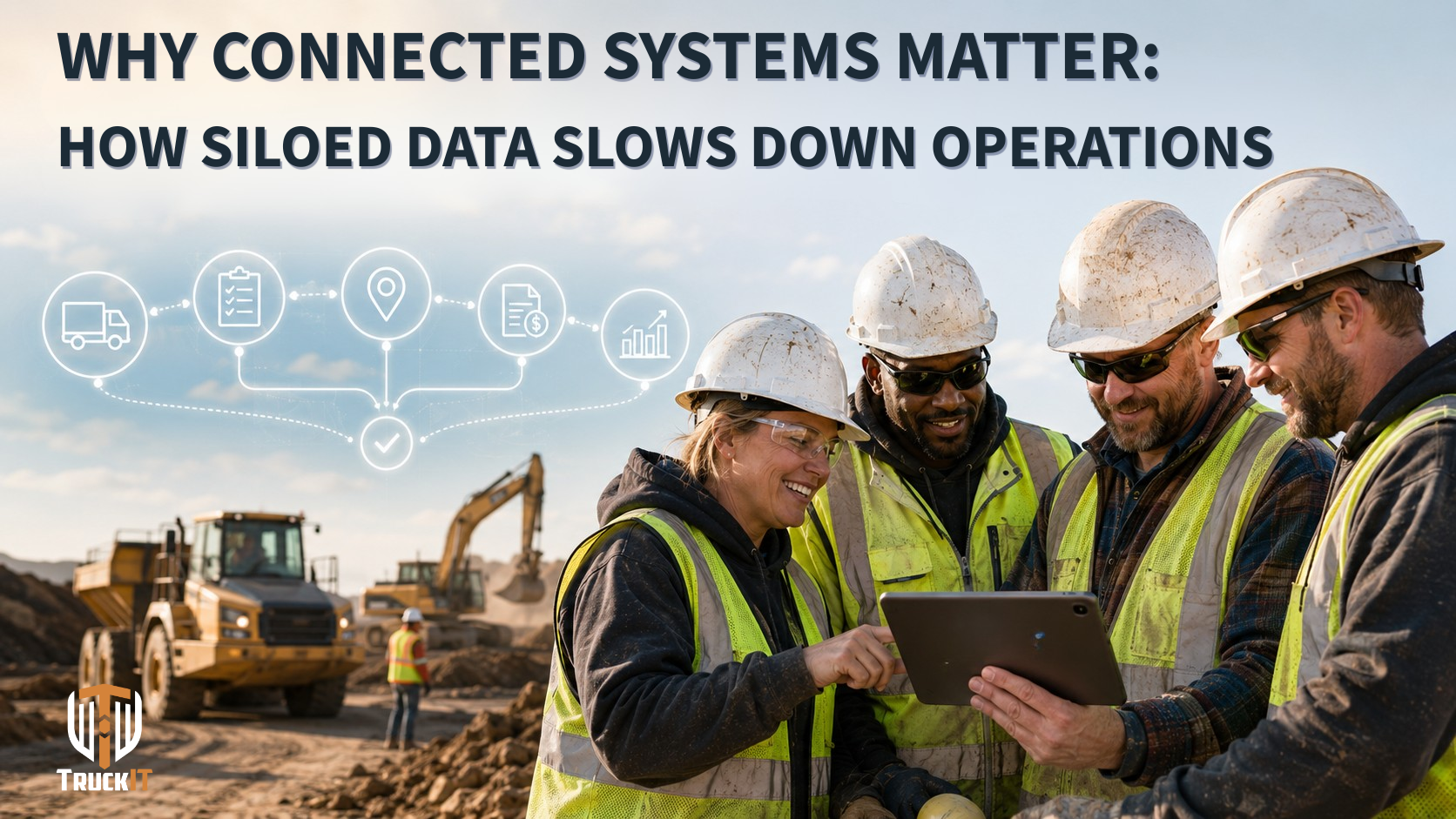
Construction companies are catching up and using more technology than ever.
That is true for contractors, haulers, material producers, brokers, DOTs, and suppliers. Dispatch platforms, telematics, accounting software, payroll tools, scalehouse systems, e-ticketing apps, and project dashboards all play a role in keeping work moving.
But here is the catch: more technology does not always mean less work.
When every system holds its own data, the job gets harder. Dispatch has one version of the truth. Accounting has another. The scalehouse yet another. Teams in the field are still chasing updates through calls, texts, paper tickets, and spreadsheets or using multiple apps.
The problem is not a lack of data. Most companies have plenty of it. The real issue is turning that data into action.
Poor system connectivity has been a known construction problem for years. NIST estimated that inadequate interoperability costs the U.S. capital facilities industry $15.8 billion per year. The AGC has also encouraged contractors to take a more strategic approach to technology adoption, including regular review of how tools perform and whether they are improving efficiency, cost, and safety.
Data Silos Turn Good Tools Into Extra Work
Most construction software is bought with the best intent.
A fleet team wants better truck visibility. Accounting wants cleaner billing. Payroll wants better hourly records. Material producers want smoother scalehouse operations. A contractor wants better jobsite updates.
Those are all fair goals. The trouble starts when those tools do not connect or talk to each other.
Now somebody has to export a report. Somebody else has to re-enter ticket data. A dispatcher has to call the driver for an update. Accounting has to wait for paper tickets. Payroll has to match driver hours against another system. Before long, the company has more software, but just as much manual work.
This becomes a digital version of the same old paperwork problem which is why you see workflows going from analog to digital and back to analog.
Pit & Quarry made this point clearly in its coverage of e-ticketing in the construction materials space: when information is not readily available, inefficiency follows. That is exactly what happens when useful data gets trapped in separate systems.
Real-Time Data Beats After-the-Fact Reports
Old data can explain what went wrong. Real-time data helps fix what is going wrong right now.
That difference matters in heavy civil work. Trucks are moving. Plants are loading. Crews are waiting. Material is being placed or not. Costs are adding up by the minute.
If trucks are stacking up at the plant, the team needs to know now and why. If a load is delayed, dispatch needs to see it now. If a ticket is missing, the back office should catch it before billing gets held up. Waiting until the end of the day may help write the report, but it will not get that lost production back.
NAPA’s efficient trucking guidance gets right to the point. It recommends monitoring cycle time and truck waiting time at the plant or jobsite so teams can spot problems and regain efficiency quickly.
That is the real value of connected data. It gives people time to act and in a way that can make a difference instead of after the fact.
E-Ticketing Shows Why Integration Matters
A ticket may look simple, but it carries a lot of weight. Essentially it’s a bill and a paycheck.
When tickets remain paper-based, the whole process slows down. Paper gets lost. Photos are hard to read. Handwriting causes mistakes. Office staff re-key in the same information. Then somebody has to reconcile it all before invoices go out.
E-ticketing helps, but only if the data can move quickly and accurately.
FHWA says e-ticketing improves the accessibility of project data and supports the electronic production, transmission, sharing, tracking, and verification of material delivery information. FHWA also notes that electronic ticket data can support acceptance, payment, and source documentation when integrated into construction or document management systems.
That last part matters. A digital ticket trapped in one system is still limited. A connected ticket can support the whole workflow from loadout to delivery to billing.
Connected Systems Keep the Field and Office on the Same Page
One load touches a lot of people.
The order can start with a project manager. Transportation is arranged and dispatch assigns the truck. The scalehouse weighs the load. The driver hauls it. The foreman or inspector verifies delivery. Then the back office uses that information for billing, payroll, job costing, and reporting.
If those handoffs are disconnected, the runaround starts.
The field knows one thing. The office knows another. The scalehouse has a record, but accounting has not seen it. The project manager wants an update, but the answer is buried in three places.
This is where integrations earn their keep because there is not a single software that can be everything to everybody.
ERP and back-office integrations matter because the field and office both depend on the same job data. When accounting, payroll, dispatch, ticketing, scalehouse, and project management systems share information, teams spend less time copying numbers between platforms and more time managing the work. Costs, quantities, tickets, hauler pay, invoices, and project records can move through the workflow with fewer manual touches.
That is the bigger point behind connected construction systems. The goal is not to add another login to keep up with. The goal is to make sure the systems a company already uses can pass clean, useful data to the next step in the job.
The best systems do not make people hunt for information. They move the right data to the right place quickly.
Universal APIs Help Companies Keep What Already Works
Most heavy civil companies are not looking to rip out every system they use.
They already have accounting software. They may already use telematics, payroll, ERP, scalehouse software, or a construction management platform. Some of those tools work just fine.
The smarter move is to connect them.
That is where Universal APIs matter. In plain English, an API lets one system share information with another. It is the bridge between tools that would otherwise sit in separate corners of the business.
TruckIT’s open API is built for that kind of connected workflow, helping link IoT devices, accounting systems, scalehouses, ERPs, telematics, and the tools companies already rely on to run their business.
For heavy civil teams, that connection can make a real difference.
Truck data can support dispatch. Ticket data can support billing. Scalehouse data can support material tracking. Driver and job data can support payroll. Project data can support reporting. The same information works harder because it is no longer stuck in one place.
The Goal Is Not More Software. It Is Better Workflows.
Construction does not need more busywork.
It needs cleaner handoffs, faster answers, fewer billing disputes, better truck utilization, and less time wasted chasing information.
Connected systems help make that happen. They reduce duplicate entries. They cut down on missing records. They give dispatchers, producers, contractors, and back-office teams a clearer view of the same job.
The companies that get the most out of technology will not be the ones with the longest software list. They will be the ones whose systems work together.
Because data by itself does not improve an operation.
Action does.
Author:
Dan Hall
curious to see what's
Under the hood?
Request a demo below... let us answer your questions and show you how TruckIT can support your team and drive performance.