
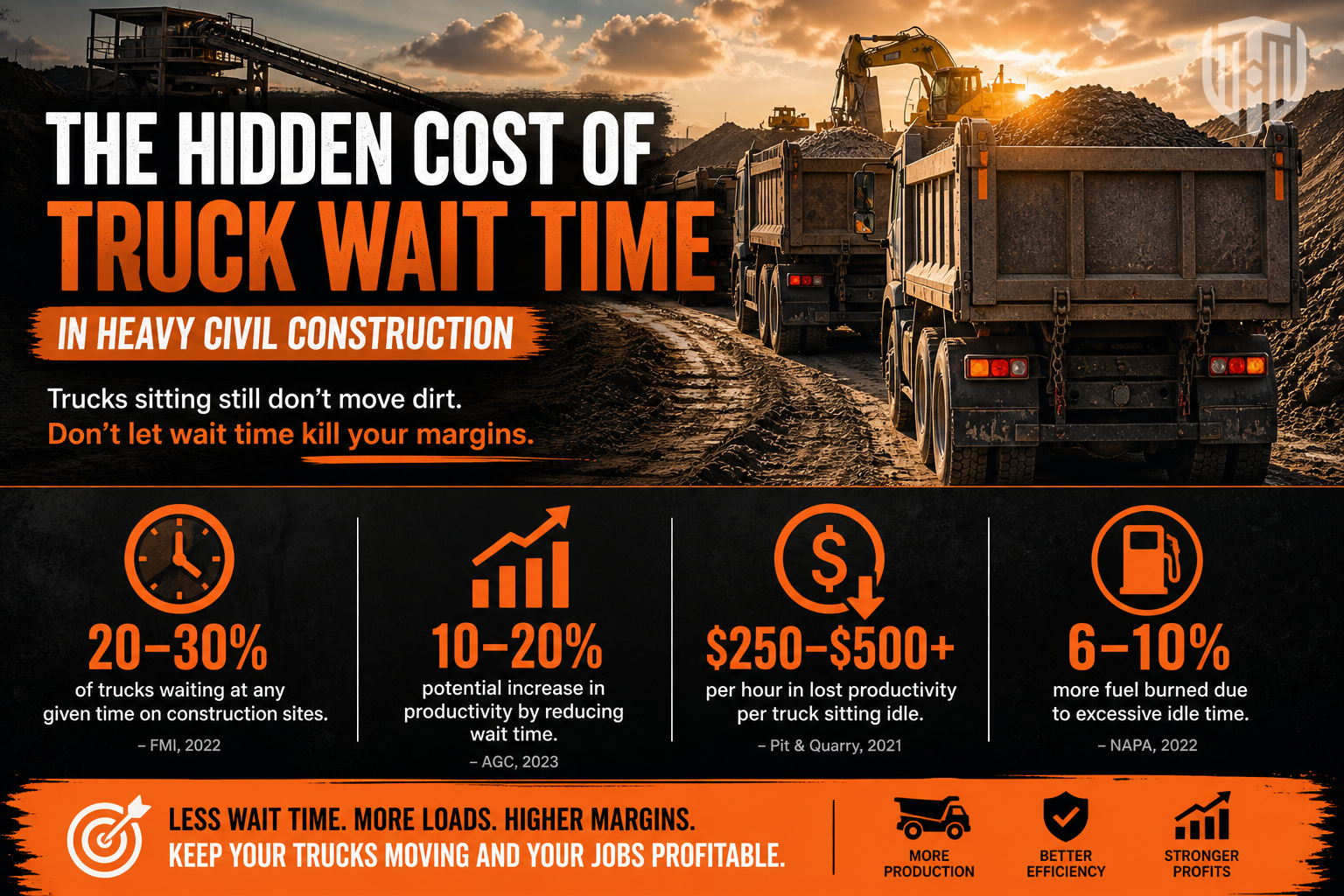
Fuel, labor, and material costs get plenty of attention in heavy civil construction. They show up on invoices, payroll reports, bid tabs, and monthly statements. But one major cost often hides in plain sight: trucks idling.
A dump truck waiting to load, waiting to dump, waiting on a ticket, instructions, or a signature costs money. The driver is on the clock. The truck is unproductive. And, the pacing of material is running behind.
The challenge with wait time is that it does not always look like waste. Sometimes it looks like a normal queue at the quarry, a slow dump zone, or a few trucks parked near the job trailer. But over a full shift, across an entire fleet, that dead time quietly eats into production and profit margins.
Hauling Is the Project's Lifeline
Heavy civil work depends on steady material movement. Dirt, stone, sand, asphalt, millings, and base material all have to move in the right order, from the right pace, to the right place, at the right time.
The scale of this type of construction work is huge. The 2025 aggregates scorecard reported U.S. aggregate production of 2.42 billion metric tons in 2023, with a value of $34.6 billion. The same report notes that transportation costs are high enough that the delivered price of sand and gravel can double at about 23 miles, and crushed rock can double at 45 miles. This is why 90% of aggregates are consumed within 50 miles of where they are produced.
Asphalt tells the same story. NAPA’s 2023 construction season survey reported asphalt mixture production of 439.7 million tons, based on responses representing 201 companies and 1,079 production plants.
In other words, this industry runs on short-haul delivery. When trucking slows down, the cost goes up and the impact can be felt across the whole project.
Wait Time Turns Working Trucks Into Parked Costs
A truck can be “on the job” without providing value.
Here’s a clear example: If 12 trucks wait 30 minutes each during a shift, that is six truck-hours gone. Use your own hourly rate and the math gets real fast. At $100 per truck-hour, that is $600 in paid time before you count lost loads, crew downtime, equipment underuse, or schedule pressure.
And fuel is only part of the story. The U.S. Department of Energy says an idling heavy-duty truck burns about 0.8 gallon of fuel per hour, and idling also adds engine wear when maintenance is tied to operating hours instead of miles.
But the bigger loss is production. A waiting truck is not hauling. A waiting crew is not placing or exporting material. A waiting loader, paver, or excavator is not working at full value.
That matters even more in today’s labor market. The Associated General Contractors (AGC) reported in 2025 that 92% of construction firms had a hard time finding qualified workers, and 45% said labor shortages caused project delays. AGC’s chief economist put it plainly: “Construction projects of all types are being delayed” because firms do not have enough qualified workers.
When good drivers and crews are hard to find, wasting their time is not a small problem. It quickly turns into a lost margin and productivity problem.
Long Turn Times Hide the Bottleneck
Turn time is the full trip cycle from pick-up to delivery. A truck loads, travels, dumps, and returns for the next load. When that cycle stretches, the project leaks efficiency.
The hard part is knowing where the time went without a breadcrumb trail.
Was the truck waiting at the plant? Was the scale backed up? Was the dump zone jammed? Did the driver wait on a foreman to confirm the drop location? Did trucks arrive in a wave instead of a staggered pattern?
A field study from Iowa State University’s Institute for Transportation demonstrated why cycle tracking matters. Researchers used GPS devices on haul trucks, an excavator, and a bulldozer to record location, speed, and rest time. They used that data to define load and dump locations, measure cycle times, and assess project productivity. The study also noted cases where equipment paused for short periods because it was waiting on direction about where material should be dumped.
That is exactly the kind of delay that can disappear in a paper log or a phone call. It feels like “just a few minutes” until it repeats all day.
Too Many Trucks Can Slow the Job Down
More trucks do not always mean more production.
If too many trucks show up at the plant at once, they stack up. If they hit the dump zone at once, they clog the site. If the loader, scalehouse, paver, or dozer cannot keep up, the extra trucks become extra cost as they wait.
Pit & Quarry puts it clearly: “Long waits erode customer profitability” because they reduce truck use and daily haul capacity. The same piece says loadout cycle time measures how fast a truck is loaded, ticketed, and released from a site.
That is the heart of the issue. Trucking is not just about having enough iron. It is about flow.
A good dispatcher is not only asking, “How many trucks do we need?” A better question is, “How many trucks can this job actually use right now?”
There is a big difference.
Not Enough Trucks Where They Are Needed Hurts Too
The opposite problem is just as costly. One job may have trucks sitting in line while another job is short. One crew may be ready for material while trucks are tied up across town. A dispatcher may think a truck is cycling back, but it is still waiting near the dump area.
That is when the phone calls start.
The superintendent calls dispatch. Dispatch calls the driver. The driver calls the plant. The foreman texts an update. Everyone is trying to do the right thing, but they are working from stale information.
This is why real-time visibility matters. Pit & Quarry covered a California producer managing a 60-truck fleet and noted that dispatch calls once took up to four hours a night. The article also described how a dispatch and telematics setup gave the company real-time cost visibility and helped reduce manual ticket entry and billing errors.
The lesson is simple: when the field and office can see the same picture, they can make better calls faster.
Ticket Times and Location Data Tell the Truth
Most hauling problems leave clues.
Pickup time, drop-off time, ticket timestamp, truck location, route history, idle time, and load count all help show what actually happened. Without that data, teams are left guessing.
A job may look short on trucks, when the real issue is slow loading. A quarry may look fine in the morning, then fall behind after lunch. A driver may look less productive, when the real issue is a bad dump pattern or repeated waiting at the scale.
E-ticketing helps here because ticket data can move through the chain faster. Pit & Quarry reported that e-ticketing platforms can give the plant, driver, crew, and customer the same ticket data at the same time, while reducing the need to collect, track, and sort paper tickets.
That is not just a back-office win. It helps operations. Better ticket data gives teams cleaner timestamps, fewer missing records, and a stronger view of load flow.
TruckIT’s platform is built around this kind of visibility. Its product materials describe real-time truck locations, ETA data, pickup and drop-off times, routes, turn-times, loads, tons, site efficiency, idle-time alerts, slow-trip alerts, geofencing, e-ticketing, dispatching, project monitoring, and load cycle analysis. TruckIT also lists automated dispatching, GPS truck tracking, project monitoring, material pacing, verified delivery, digital ticketing, reporting, and actionable insights as part of its core solution.
That is the kind of information dispatchers and project teams need while the job is still running, not three days later when someone is trying to explain a missed target.
The Real Cost Is Missed Production
Truck wait time is not just a fuel issue. It is not just a driver issue. It is a production issue.
Long waits can mean fewer loads per shift, poor truck use, higher hourly costs, missed plant or paving targets, frustrated crews, billing disputes, and more pressure on dispatch. On tight-margin work, that adds up fast.
The companies that get ahead of this problem do not just buy more trucks or push drivers harder. They look at the cycle. They watch the load flow. They measure wait time at the plant, quarry, scale, haul route, and dump zone. Then they adjust.
Sometimes the fix is better staggering. Sometimes it is fewer trucks. Sometimes it is a cleaner dump pattern, better field instructions, a different start time, or faster ticket handling.
The point is not to flood the team with reports. The point is to give good people better information so they can keep the job moving.
Conclusion
Truck wait time is easy to overlook because it feels normal. A few trucks in line. A slow ticket. A driver waiting on instructions. A dump zone that gets backed up for half an hour.
However, these small delays compound across trucks, shifts, and projects.
Heavy civil construction runs on movement. The contractors, haulers, brokers, and material producers who track cycle times, minimize idling, and act on real-time data squeeze more production from the trucks they already have, keeping projects on time and on budget.
Author:
Dan Hall
curious to see what's
Under the hood?
Request a demo below... let us answer your questions and show you how TruckIT can support your team and drive performance.