
.jpg)
By the TruckIT Editorial Team | Expert review by TruckIT's Product & Operations Team | Updated September 8, 2026
Quick answer: The best construction dispatch software depends on what your company dispatches. TruckIT is designed for repetitive bulk-material hauling and e-ticketing; HCSS HeavyJob Resource Planner focuses on crews and equipment; Veyor manages jobsite delivery scheduling and access; DispatchTrack supports multi-stop building-material delivery; and Samsara is strongest in fleet telematics, safety, and asset visibility.
Construction dispatch software helps contractors, haulers, material producers, and project teams coordinate trucks, drivers, equipment, materials, and deliveries without relying on disconnected spreadsheets, phone calls, text messages, and paper records.
However, “construction dispatch” describes several different workflows. Some platforms schedule crews and heavy equipment. Others coordinate delivery windows at congested jobsites, optimize multi-stop routes, or monitor vehicles and assets. Companies hauling aggregate, asphalt, dirt, stone, concrete, and other bulk materials have an additional set of requirements: repeated short-haul cycles, changing truck assignments, owned and third-party capacity, material quantities, scale tickets, delivery verification, and reconciliation.
This guide compares five platforms according to the primary construction workflow each one is designed to support.
Editorial disclosure: TruckIT publishes this guide and is included in the comparison. We grouped the platforms according to their publicly documented primary workflows and capabilities as of September 2026. This is a representative, not exhaustive, list, and product capabilities and packaging may change.
In This Guide
- Quick comparison of construction dispatch platforms
- Five platforms by use case
- What to look for in construction dispatch software
- Construction dispatch versus fleet management
- Construction dispatch versus a trucking TMS
- Frequently asked questions
Quick Comparison of Construction Dispatch Platforms
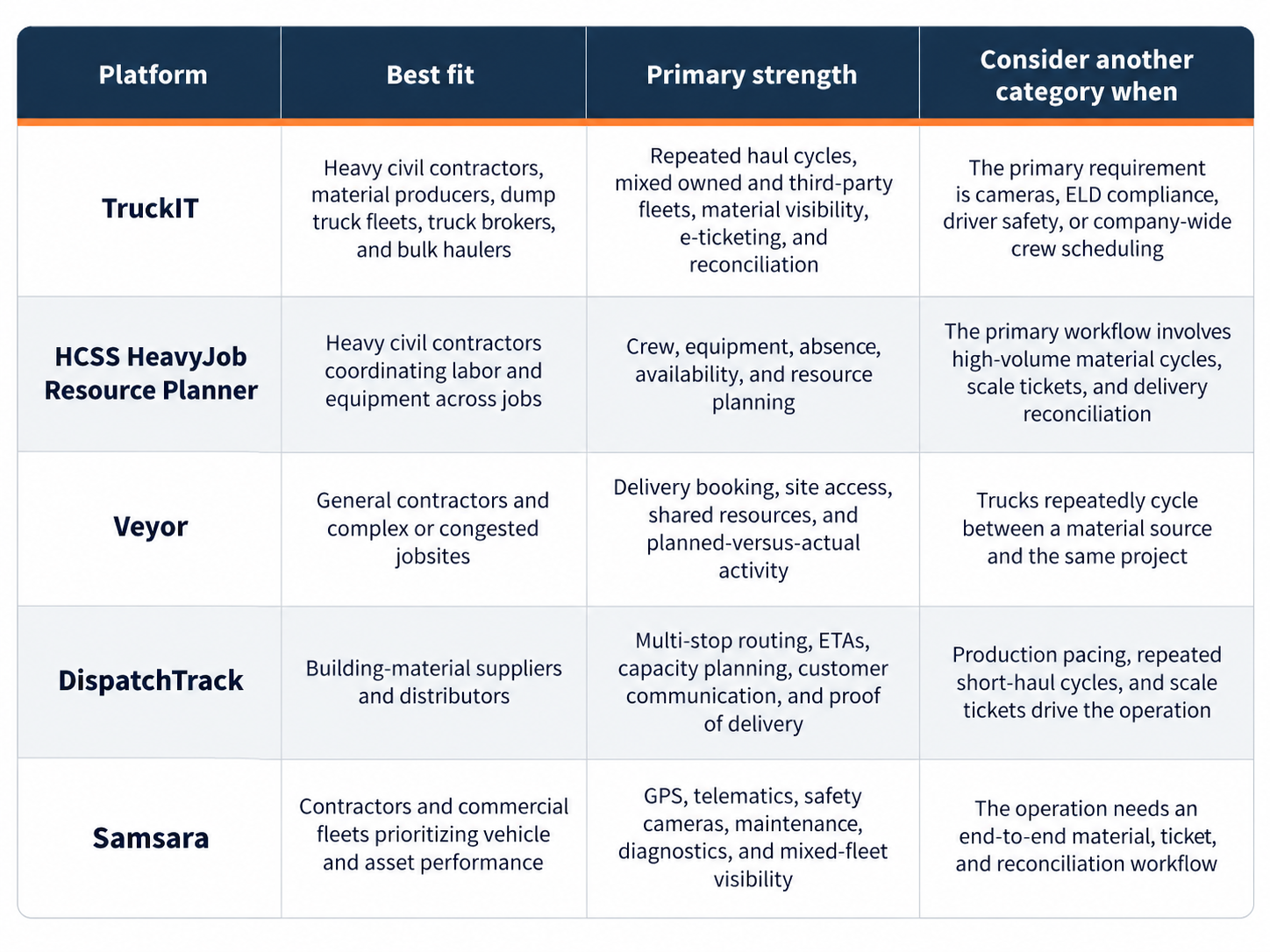
The distinction is important: software that can display trucks on a map is not necessarily designed to control a heavy-construction material workflow from dispatch through ticketing and billing.
1. TruckIT: Best for Heavy Construction Material Hauling
TruckIT is construction dispatch and e-ticketing software built around heavy hauling and the construction material chain of custody. It connects dispatchers, drivers, field teams, material sources, tickets, delivery records, and back-office workflows in one platform.
That specialization matters because bulk-material hauling is different from traditional freight and last-mile delivery. A dump truck may make repeated trips between a quarry, asphalt plant, concrete plant, or other material source and the same project throughout the day. Production rates change, trucks are reassigned, third-party haulers are added, and jobs can slow down or stop with little warning.
Core TruckIT Capabilities
- Dynamic dispatch: Dispatchers can assign company-owned and third-party trucks, monitor job progress, change start times or quantities, and reassign capacity as conditions change. TruckIT's dispatch optimization tools include Smart Dispatch capabilities for planning and scheduling around operational requirements.
- Truck, load, and material visibility: Teams can connect truck activity with jobs, pickups, drop-offs, loads, quantities, cycle times, ETAs, and project progress. Business intelligence and reporting help teams identify wait time, pacing problems, missing information, and operational exceptions.
- Digital tickets and e-ticketing: TruckIT's e-ticketing solutions include Digital Tickets, Automatic-PIC, AirTicket™, Bulk Reconcile, and Verified Delivery. Automatic-PIC extracts data from printed and handwritten tickets, while AirTicket transmits ticket data electronically from the scalehouse.
- Driver and field communication: The TruckIT mobile app gives drivers and field users role-specific access to assignments, locations, directions, job notes, notifications, and ticket information.
- Reconciliation and back-office workflows: TruckIT can connect field records with ticket approval, reconciliation, billing, payroll, payment, accounting, ERP, scalehouse, and other business workflows through its fleet performance and integration capabilities.
The value is not simply knowing where a truck is. The larger question is whether the operation is moving enough material to keep production on pace—and whether every completed load produces an accurate, usable record.
The Federal Highway Administration identifies improved material-data exchange, delivery verification, inspection efficiency, safety, and payment processing among the benefits of construction e-ticketing. Connecting tickets with dispatch and delivery activity lets information move with the load instead of being reconstructed days later. See the FHWA's e-ticketing resources for additional background.
Customer Evidence
In TruckIT's published N.W. White heavy-hauling case study, the eight-division operation with more than 300 trucks reported cutting one to three hours from next-day dispatch planning. Digitized tickets also supported next-day billing and payments while giving dispatchers, drivers, and customers more timely operational information.
When TruckIT May Not Be the Primary Fit
An organization whose main requirement is dash cameras, ELD compliance, driver coaching, or preventative maintenance may need a telematics-first platform. A contractor focused mainly on assigning employees and heavy equipment across projects may prefer a construction resource-planning system. Those systems can also complement TruckIT when a business needs both asset intelligence and a specialized material-hauling workflow.
Best for: Heavy civil and infrastructure contractors, aggregate and asphalt producers, dump truck companies, truck brokers, bulk haulers, and organizations managing both owned and third-party trucks.
2. HCSS HeavyJob Resource Planner: Best for Crew and Equipment Scheduling
Readers researching construction dispatch may still encounter the HCSS Dispatcher name. HCSS now directs users looking for Dispatcher toward HeavyJob Resource Planner, its construction resource-planning solution for coordinating people and equipment.
The platform is built around questions such as: Which crew is available? Where is a specific machine assigned? Which project needs an employee or piece of equipment next? Are absences or conflicting assignments creating a resource gap?
HeavyJob Resource Planner provides views of labor, equipment, availability, absences, requests, and assignments. Its drag-and-drop scheduling helps contractors plan by day, week, month, or project and communicate updated plans to the field. This makes it a natural fit for heavy civil contractors distributing resources across multiple active jobs.
Its primary organizing unit is the construction resource rather than the material-hauling cycle. Contractors whose central challenge is moving aggregate, asphalt, dirt, or other bulk materials should also evaluate how the system handles repeated loads, changing truck cycles, scale tickets, material quantities, delivery verification, and reconciliation.
Best for: Civil and infrastructure contractors whose primary dispatch challenge is coordinating crews, equipment, availability, and resource assignments across jobsites.
3. Veyor: Best for Complex Jobsite Delivery Coordination
Veyor approaches construction logistics primarily from the jobsite side. Its platform is designed around delivery bookings, site access, shared-resource scheduling, driver communication, and visibility into planned and actual activity.
That model can be valuable on large, congested, or highly controlled projects. Multiple suppliers and subcontractors may need access to the same gate, crane, loading zone, staging area, hoist, or delivery window. Poor coordination can create congestion before a vehicle reaches its unloading point.
Veyor's documented capabilities include linked asset scheduling, a live activity map, bulk schedule changes, driver routing and communication, access-point controls, planned-versus-actual tracking, and digital compliance workflows. It also supports integrations such as Procore for connected inspections and quality-control activity.
This is a different operating problem from controlling a fleet of dump trucks repeatedly cycling between a material source and one or more projects. In that environment, dispatch timing, production pacing, load quantities, scale tickets, and cycle performance may carry more weight than delivery-slot management.
Best for: General contractors and major projects where delivery bookings, controlled site access, shared-resource scheduling, and congestion management are the primary challenges.
4. DispatchTrack: Best for Last-Mile Building-Material Delivery
DispatchTrack is oriented toward delivery planning and execution. Its capabilities include route optimization, driver route execution, delivery tracking, fleet-capacity management, customer communication, ETAs, and proof of delivery.
This makes it a strong fit for companies delivering lumber, doors, windows, fixtures, plumbing supplies, landscaping products, and other packaged or unitized building materials. These operations often involve multiple unrelated stops, different customer delivery windows, and a need to keep contractors informed about arrival times.
DispatchTrack also addresses delivery capacity across internal fleets and third-party logistics partners, which can be valuable for suppliers managing fluctuating demand. Its customer-experience orientation helps distributors coordinate warehouse, driver, and recipient activity through the final delivery.
That multi-stop distribution model differs from a dump truck making repeated cycles between an aggregate source and a project. Bulk-material operations should determine whether a platform connects production pacing, material quantities, scale tickets, repeated loads, subcontracted haulers, and reconciliation—not just route stops and proof of delivery.
Best for: Building-material suppliers and distributors that need multi-stop routing, capacity planning, ETAs, customer communication, and proof of delivery.
5. Samsara: Best for Construction Fleet Telematics
Samsara for Construction is a connected-operations and fleet-management platform centered on mixed-fleet visibility, safety, vehicle cameras, GPS tracking, maintenance, diagnostics, fuel performance, and equipment monitoring.
For construction companies, those capabilities help answer important asset questions: Where is the truck or machine? How much is it idling? How is the vehicle being driven? When is maintenance due? Is an asset being fully utilized? Could a developing fault cause downtime?
Samsara also offers routing and dispatch, driver assignment, commercial navigation, location-based reporting, and asset scheduling. Its construction positioning, however, begins with the vehicle, worker, or asset rather than the full construction material chain of custody.
A telematics system and construction dispatch platform do not always have to compete. Some organizations use telematics to capture vehicle, safety, and engine data while a construction operations platform manages orders, repeated haul cycles, material deliveries, tickets, and reconciliation.
Best for: Contractors and commercial fleets whose main requirements are GPS, safety, cameras, maintenance, diagnostics, fuel reporting, and mixed-fleet asset visibility.
What to Look for in Construction Dispatch Software
The right platform should reflect how work moves through your company—not simply provide the longest feature list. Evaluate the complete workflow from the original order or request through dispatch, delivery, ticketing, reconciliation, and billing.
Seven Questions to Ask During a Software Demonstration
- Can the provider demonstrate your actual operating cycle? If you run dump trucks, ask to see repeated loads, changing truck assignments, owned and subcontracted haulers, and rates by hour, ton, load, cubic yard, distance, or material—not a generic dispatch screen.
- What happens when the morning plan changes? Ask the provider to reassign trucks after a breakdown, plant delay, weather event, job shutdown, or sudden request for additional capacity.
- What does the driver have to do? Count the taps, manual entries, phone calls, and separate applications required to receive an assignment, update status, document a ticket, and confirm delivery.
- Can field teams see whether material is keeping pace with production? GPS location alone may not reveal load counts, tons delivered, cycle time, wait time, or whether the job is ahead of or behind plan.
- Can you follow one ticket from the scalehouse to accounting? Ask how a ticket is captured, validated, matched to a load, corrected, approved, reconciled, exported, billed, and used to support hauler payment.
- What information moves automatically between systems? Verify the depth and frequency of connections with accounting, ERP, payroll, telematics, scalehouse, project-management, and payment systems. Ask where employees will still re-enter data.
- How will implementation and adoption be measured? Establish expectations for training, driver adoption, support, data migration, integrations, reporting, and measurable operational outcomes before signing an agreement.
The best demonstration is a realistic exception-driven scenario. A perfect schedule created with clean sample data reveals much less than watching the provider handle the problems your dispatchers face every day.
Construction Dispatch Software vs. Fleet Management Software
Construction dispatch software assigns resources to work; fleet management software monitors the condition and performance of vehicles and assets. The capabilities can overlap, but their primary purposes are different.
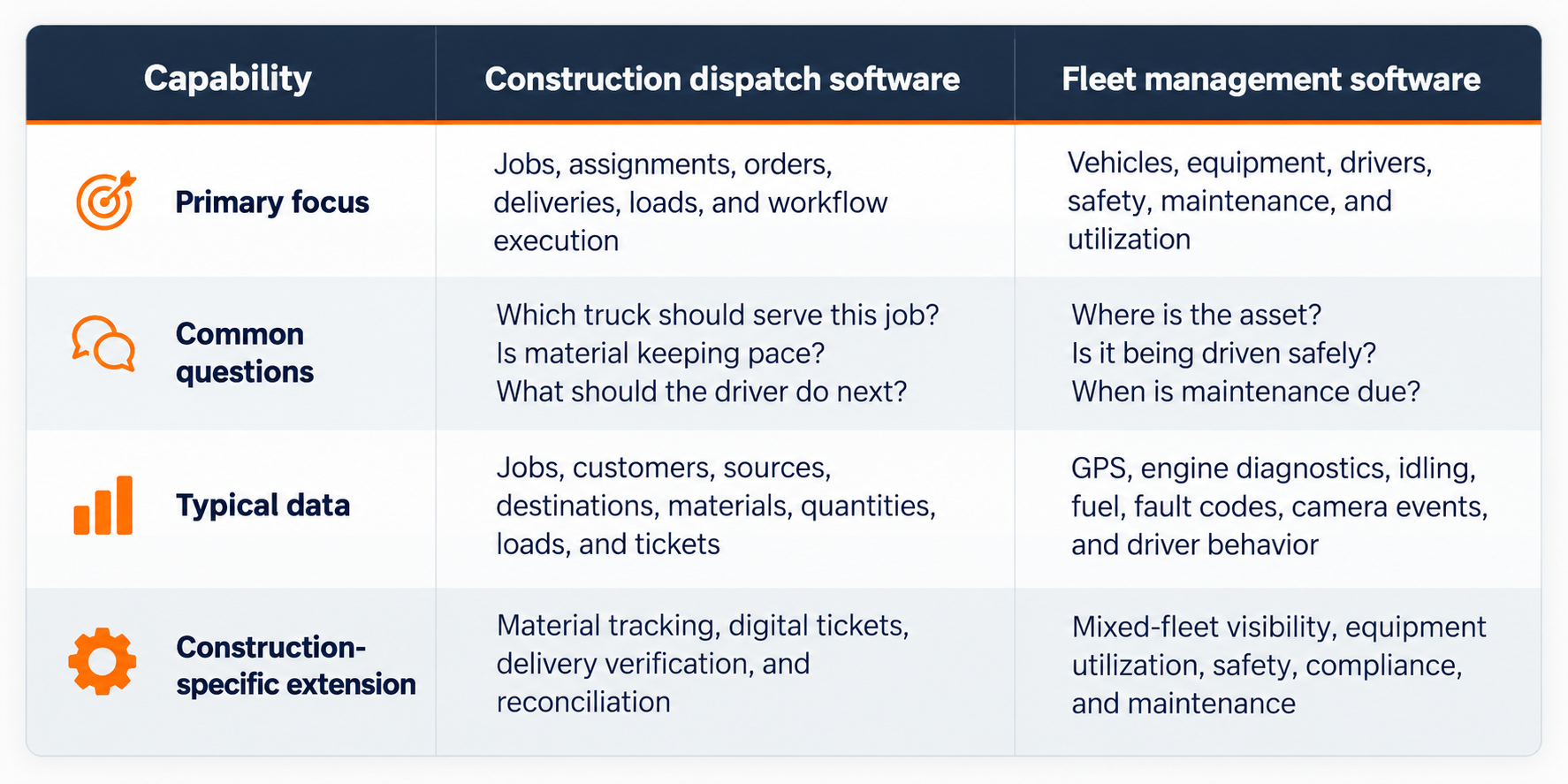
For bulk-material hauling, the ideal technology setup may connect both layers: telematics supplies vehicle and asset information, while construction dispatch software uses operational data to manage jobs, loads, materials, tickets, and completed work.
Construction Dispatch Software vs. a Trucking TMS
A traditional transportation management system usually organizes freight from an origin to a destination; construction hauling often requires repeated short-haul cycles whose timing changes with production. That difference affects dispatch, pricing, documentation, and performance measurement.
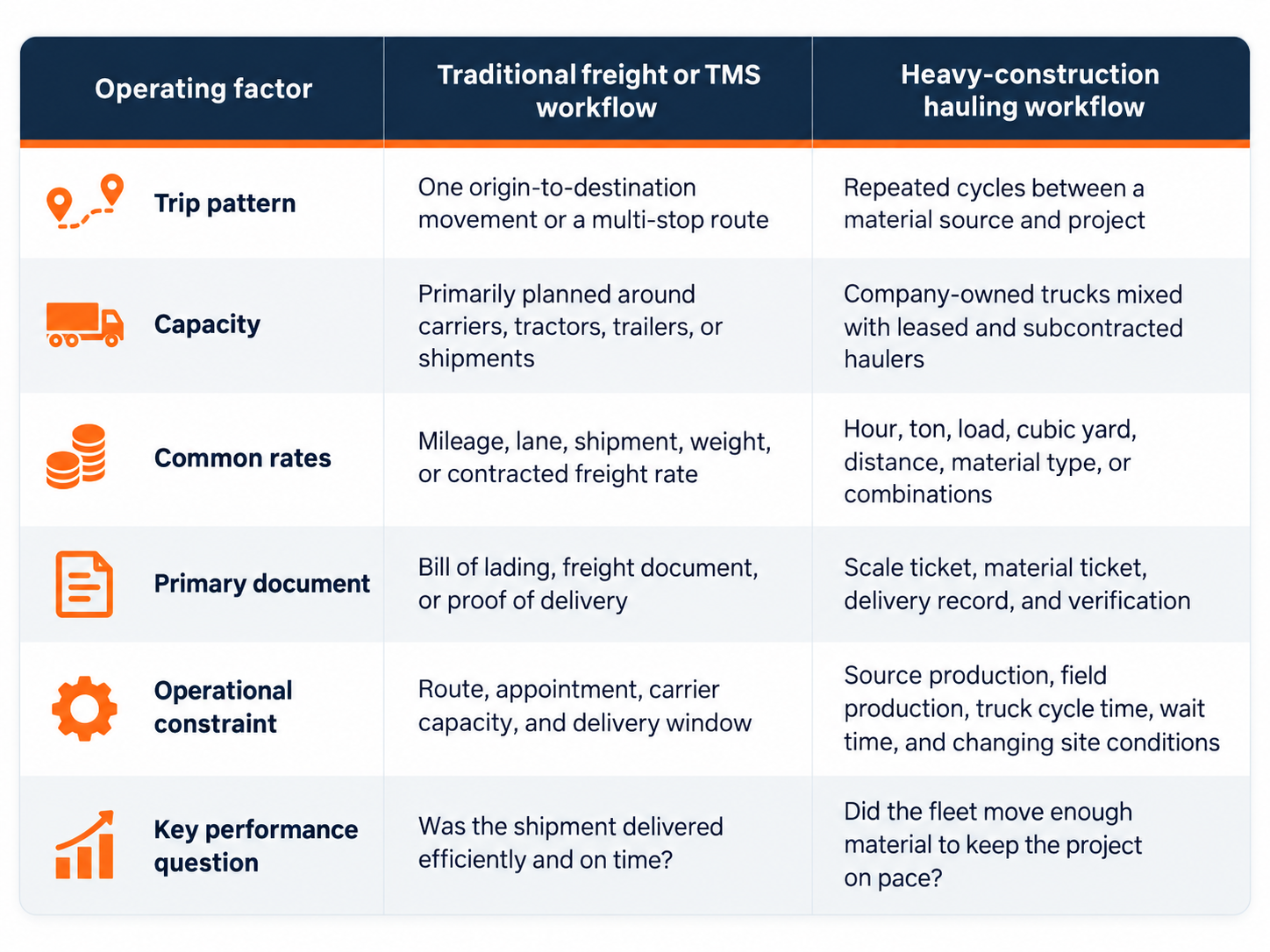
Companies hauling aggregate, asphalt, dirt, stone, concrete, and other bulk materials should confirm that a platform understands this repeated-cycle workflow. Having a dispatch screen does not necessarily mean a system is designed for construction material hauling.
Which Construction Dispatch Software Is Right for Your Operation?
Choose according to the workflow you most need to control:
- Choose TruckIT when repeated material-hauling cycles, mixed owned and third-party fleets, digital tickets, delivery verification, reconciliation, and back-office connectivity drive the operation.
- Choose HCSS HeavyJob Resource Planner when the primary challenge is assigning employees and equipment across construction projects.
- Choose Veyor when delivery bookings, gates, loading zones, cranes, access controls, and shared jobsite resources require coordination.
- Choose DispatchTrack when building materials move through multi-stop routes and customer delivery windows with ETAs and proof of delivery.
- Choose Samsara when GPS, cameras, driver safety, diagnostics, maintenance, fuel performance, and mixed-fleet visibility are the leading priorities.
Some companies will need more than one category. The objective is not to force every operational requirement into a single product. It is to reduce the manual handoffs between dispatchers, drivers, field teams, fleet managers, and the office while maintaining a reliable record of what happened.
If your team is still connecting dispatch, drivers, material deliveries, tickets, and reconciliation through spreadsheets, texts, phone calls, and paper, see how TruckIT brings the heavy-hauling workflow together.
Schedule a TruckIT heavy-hauling workflow demo
Frequently Asked Questions
What Is Construction Dispatch Software?
Construction dispatch software helps contractors, hauling companies, and material producers assign trucks, drivers, equipment, or crews to work and communicate those assignments to the field. Depending on the platform, it may also include GPS visibility, load tracking, material management, digital tickets, reporting, reconciliation, and accounting or ERP integrations.
What Is the Best Dispatch Software for Dump Trucks?
The best dispatch software for dump trucks should support repeated short-haul cycles, owned and third-party capacity, changing assignments, rates by hour, ton or load, material quantities, scale tickets, delivery verification, and reconciliation. TruckIT is designed specifically around this heavy-construction material-hauling workflow.
What Is Aggregate Dispatch Software?
Aggregate dispatch software coordinates trucks hauling sand, gravel, crushed stone, and other aggregates from pits, quarries, and plants to construction projects or other destinations. It can help dispatchers assign trucks, track repeated loads, monitor tons and cycle times, communicate with drivers, and connect scale tickets with completed deliveries.
Can Construction Dispatch Software Manage Third-Party or Leased Trucks?
Some construction dispatch platforms support company-owned, leased, and subcontracted trucks in the same workflow. This is especially important for contractors, brokers, producers, and hauling companies that add outside capacity as project demand changes. TruckIT supports dispatch workflows involving owned and third-party haulers.
Can Construction Dispatch Software Eliminate Paper Tickets?
Some platforms can reduce or replace paper-ticket workflows by creating digital tickets, photographing paper tickets, extracting ticket data, or receiving electronic information directly from a scalehouse. TruckIT supports Digital Tickets, Automatic-PIC for printed and handwritten tickets, and AirTicket for electronic scalehouse ticket transmission.
What Is E-Ticketing in Construction?
Construction e-ticketing replaces or supplements paper material tickets with digital delivery records. An e-ticket may include the ticket number, truck, hauler, material, quantity, source, destination, date, time, and delivery verification. Digital records help inspectors, contractors, producers, field teams, accounting staff, and hauling partners work from consistent delivery information.
Can Dispatch Software Track Aggregate and Material Deliveries?
Yes, when the platform is designed for construction materials. It can connect truck activity with load counts, tons or other quantities, pickup and drop-off activity, cycle times, project progress, and ticket records. This helps contractors and producers determine whether deliveries are keeping pace with field production.
What Is the Difference Between Dispatch Software and GPS Fleet Tracking?
GPS fleet tracking primarily shows the location, utilization, safety, and mechanical activity of vehicles and equipment. Construction dispatch software focuses on assigning resources to jobs and coordinating the work they need to complete. Construction-specific platforms may go further by connecting dispatch with loads, materials, tickets, delivery verification, and reconciliation.
Does Construction Dispatch Software Integrate With Accounting Software?
Many construction dispatch platforms offer APIs, exports, or integrations with accounting and ERP systems, although the depth of those connections varies. Ask which records move between systems, how frequently data is synchronized, how errors are handled, and where employees will still need to enter or reconcile information manually.
Author:
Dan Hall
curious to see what's
Under the hood?
Request a demo below... let us answer your questions and show you how TruckIT can support your team and drive performance.